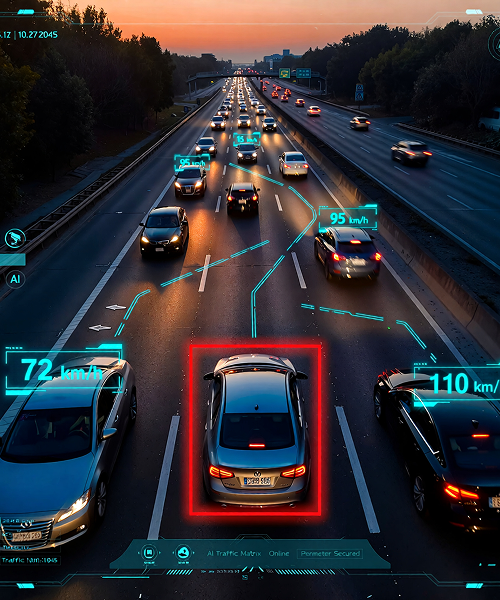
Trafic Signal Monitoring
AI-driven Traffic Signal Monitoring enhances road safety, streamlines traffic flow, and supports intelligent traffic control across industrial and urban environments. The system continuously analyzes vehicle movement, signal compliance, and congestion patterns to optimize traffic and parking management. It integrates advanced number plate recognition to validate vehicles and track entries in real time. Geo-fenced and restricted zones are automatically monitored to prevent unauthorized access and improve operational discipline. The solution also detects road incidents, overspeeding, and wrong-way driving—ensuring faster response and safer mobility across all routes. This proactive platform delivers a smarter, safer, and more efficient traffic ecosystem.
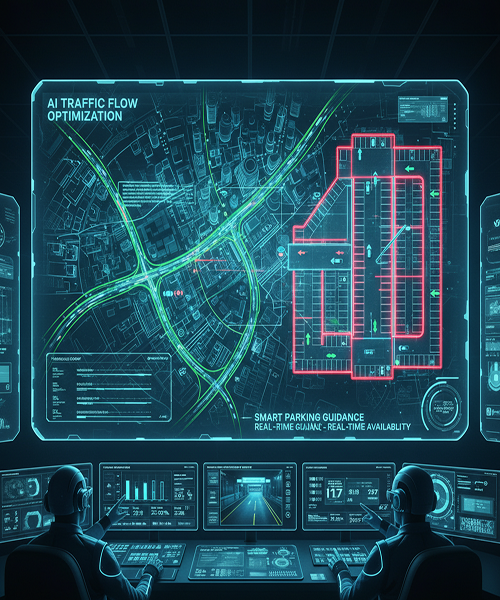
Intelligent Traffic & Parking Efficiency Management
A large industrial campus faced frequent traffic congestion, disorganized parking, and long vehicle queues during shift start and end times. Manual monitoring struggled to track vehicle movement, enforce parking rules, and optimize space utilization. This led to delays, safety concerns, unauthorized parking, and inefficient use of parking zones.
The organization deployed an AI-powered Traffic & Parking Management System that uses intelligent cameras to monitor vehicle flow, guide drivers to available spaces, and detect rule violations in real time. Automated alerts, digital logs, and optimized traffic routing improved vehicle circulation, reduced congestion, and enhanced parking efficiency across entry and exit points.
- Real-Time Parking Space Availability
- Intelligent Traffic Flow Monitoring
- Automated Parking Rule Enforcement
Business Impact
- ✓Reduced congestion and improved traffic movement during peak hours.
- ✓Optimized parking space usage, lowering operational overhead.
- ✓Improved visitor and employee experience with smoother entry/exit.
Business Impact
- ✓ Faster vehicle entry processing with reduced gate delays.
- ✓ Strengthened perimeter security and access accountability.
- ✓ Accurate, time-stamped vehicle logs for audits and investigations.

AI-Powered Vehicle Number Plate Identification System
The facility struggled to track vehicle entries and exits using manual logs and security checkpoints. Unauthorized vehicles entered unnoticed, and record-keeping was inconsistent, causing security gaps and delays at access gates. This also made investigation and audit processes time-consuming.
The organization implemented an AI-driven Number Plate Recognition (ANPR) System using high-accuracy license plate scanning. The system automatically captures plate numbers, verifies authorized vehicles, and logs every entry and exit with timestamps—ensuring fast access control, accurate reporting, and enhanced perimeter security.
- Automated Number Plate Capture & Verification
- Instant Vehicle Access Logging
- Improved Gate Security & Audit Accuracy
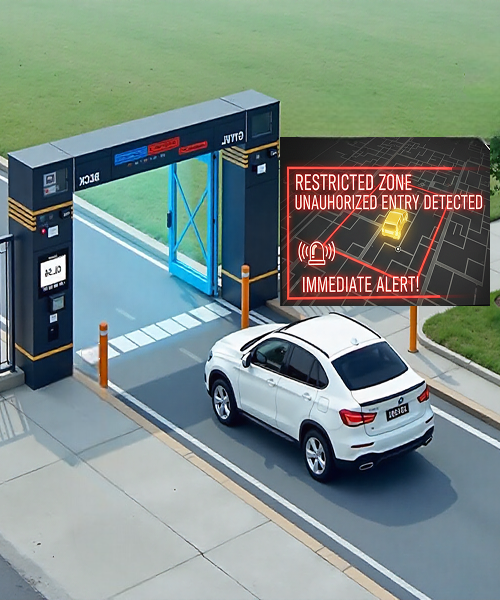
Advanced Restricted Zone Vehicle Monitoring System
The manufacturing facility had high-risk areas where vehicle access was strictly restricted. Manual monitoring often failed to detect unauthorized vehicle movement into these zones, resulting in safety hazards, workflow disruption, and asset damage risks.
To address this, the organization deployed an AI-enabled Restricted Area Detection System. Intelligent cameras continuously monitor critical zones and instantly flag unauthorized vehicle entry. Automated alerts enable quick response, prevent accidents, and ensure only approved vehicles operate within designated areas.
- Real-Time Unauthorized Vehicle Detection
- Virtual Restricted Zone Monitoring
- Automated Alerting for Quick Response
Business Impact
- ✓Minimized safety risks by preventing unauthorized zone entries.
- ✓Reduced operational disruptions caused by accidental intrusions.
- ✓Improved compliance with site safety and mobility regulations.
Business Impact
- ✓Faster resolution of road incidents and improved traffic safety.
- ✓Reduced downtime from stalled or damaged vehicles.
- ✓Increased situational awareness across all internal roads.
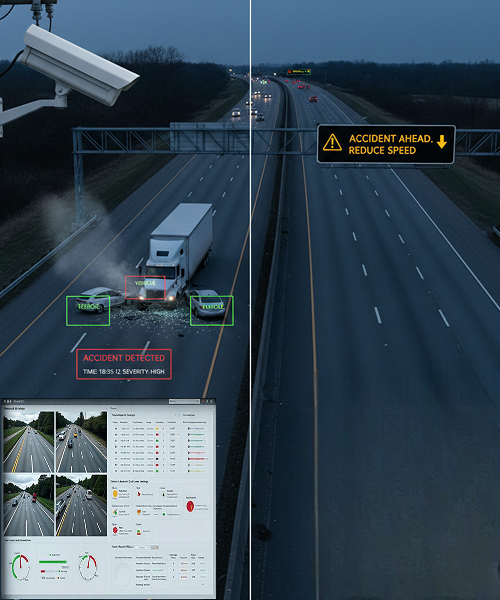
Real-Time Road Incident Surveillance & Alerting System
The campus experienced road incidents such as sudden stops, collisions, stalled vehicles, and unsafe driving behaviors. Manual tracking was slow, resulting in delayed response and prolonged disruptions across key internal roads.
With the adoption of an AI-based Road Incident Detection System, the facility gained real-time monitoring of roadway activity. The system automatically detects collisions, vehicle breakdowns, abrupt speed changes, and unsafe movements—allowing security teams to act quickly and restore normal flow while reducing risk.
- Real-Time Accident & Breakdown Detection
- Unsafe Driving Behavior Monitoring
- Faster Emergency Response & Incident Logging
Vehicle Speed & Wrong-Way Violation Detection Platform
High-speed driving and wrong-way vehicle movement inside the facility posed serious safety risks and frequently caused near-miss incidents. Manual supervision was ineffective for detecting violations in real time across large road networks.
The organization deployed an AI-powered Speed & Wrong-Way Vehicle Detection System that continuously analyzes vehicle movement patterns. The system instantly identifies overspeeding, wrong-direction entry, and risky driving behaviors—triggering alerts that help prevent accidents and reinforce traffic discipline.
- Instant Overspeeding Detection
- Wrong-Way Vehicle Movement Alerts
- Improved Internal Traffic Safety
Business Impact
- ✓Reduced high-risk driving behaviors across facility routes.
- ✓Lower accident probability with proactive violation alerts.
- ✓Stronger adherence to internal traffic rules and safety norms.